
How to Respond to Reviews Like a Pro + Useful Examples
Review response management is the practice of engaging with customer feedback on public platforms to shape brand perception. It works by acknowledging both positive and negative feedback through personalized, timely replies that address specific customer experiences. This process is essential for building trust with prospective buyers and improving a business’s online reputation. Understanding how to respond to online reviews is a critical skill for modern business success.
Most business owners barely think about their review replies. They dash off a quick thanks on the good ones and, when a nasty one shows up, either ignore it or fire back defensively. That is a shame, because knowing how to respond to reviews is one of the cheapest ways to earn trust with the customer reading along.
That is exactly what we are going to fix here. We will show you why replying to reviews pays off and 10 ways to handle every kind of review. You will also see 4 businesses that get review responses right and what you can borrow from each.
Why Responding to Reviews Is Worth Your Time: 4 Key Benefits for Businesses
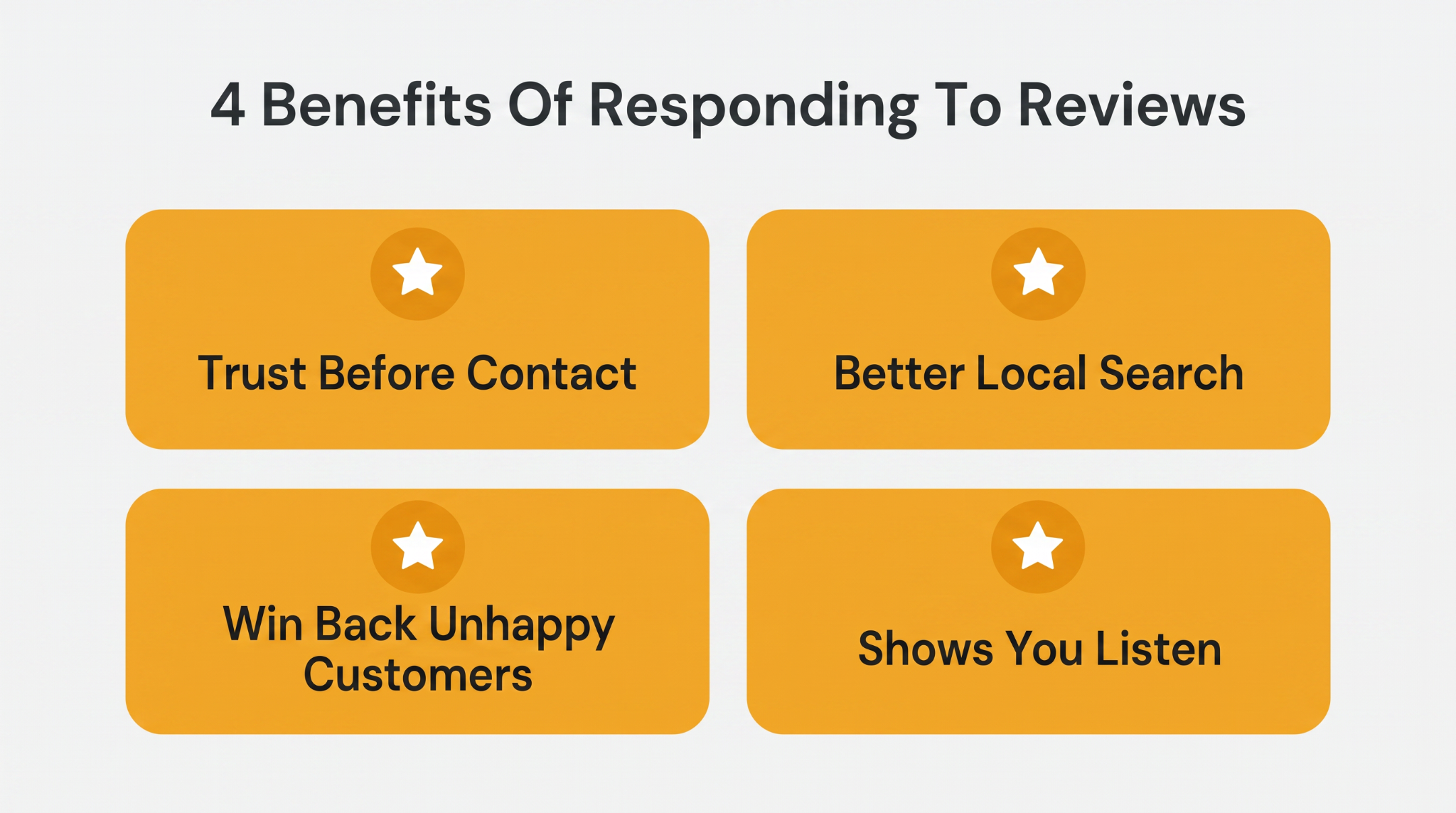
Replying does take time, and you deserve to know what you get for it. There are 4 solid payoffs, and together they make how to respond to reviews worth carving out space for each week.
1. Builds Trust Before Prospects Ever Contact You
Most people size you up while scrolling your reviews, well before they call or fill out a form. A thoughtful reply tells those new customers you are around and you actually care how things went. In fact, 48% of people say seeing a business respond builds their trust, so you are earning it before a conversation even starts.
2. Strengthens Your Search Visibility
Google pays attention to businesses that stay active. Every reply you post adds fresh, keyword-rich text to your profile and signals that someone is home. Both of those things help you turn up in local search. Leave your reviews untouched, and you look dormant, which is the last impression you want to give a stranger.
Over time, a steady habit of answering reviews becomes a ranking signal your lazier competitors never get around to building. And those replies strengthen your online reputation as well. It is slow going, and it compounds, which makes it the kind of advantage nobody can copy overnight.
3. Turns Unhappy Customers Into Loyal Customers
A complaint isn’t a dead end. Handle it well and own whatever went wrong. It improves customer satisfaction and customer loyalty long after the original problem. A frustrated customer usually comes back warmer than a lukewarm one ever was.
This genuinely changes minds and customer relationships, too. 56% of people say they changed their opinion of a business based purely on how it answered a review. And that is good for trust and customer retention alike.
4. Shows Future Buyers You Actually Listen
Every reply is a little preview of how you treat people. Positive reviews show what happened. Your replies show how you treat people. Future buyers read through your responses to work out whether you shrug off criticism or take it to heart.
Human replies show them you are genuinely listening. And that alone sets you apart from the crowd of businesses that never reply to dissatisfied customers.
10 Effective Strategies for Responding to Online Reviews
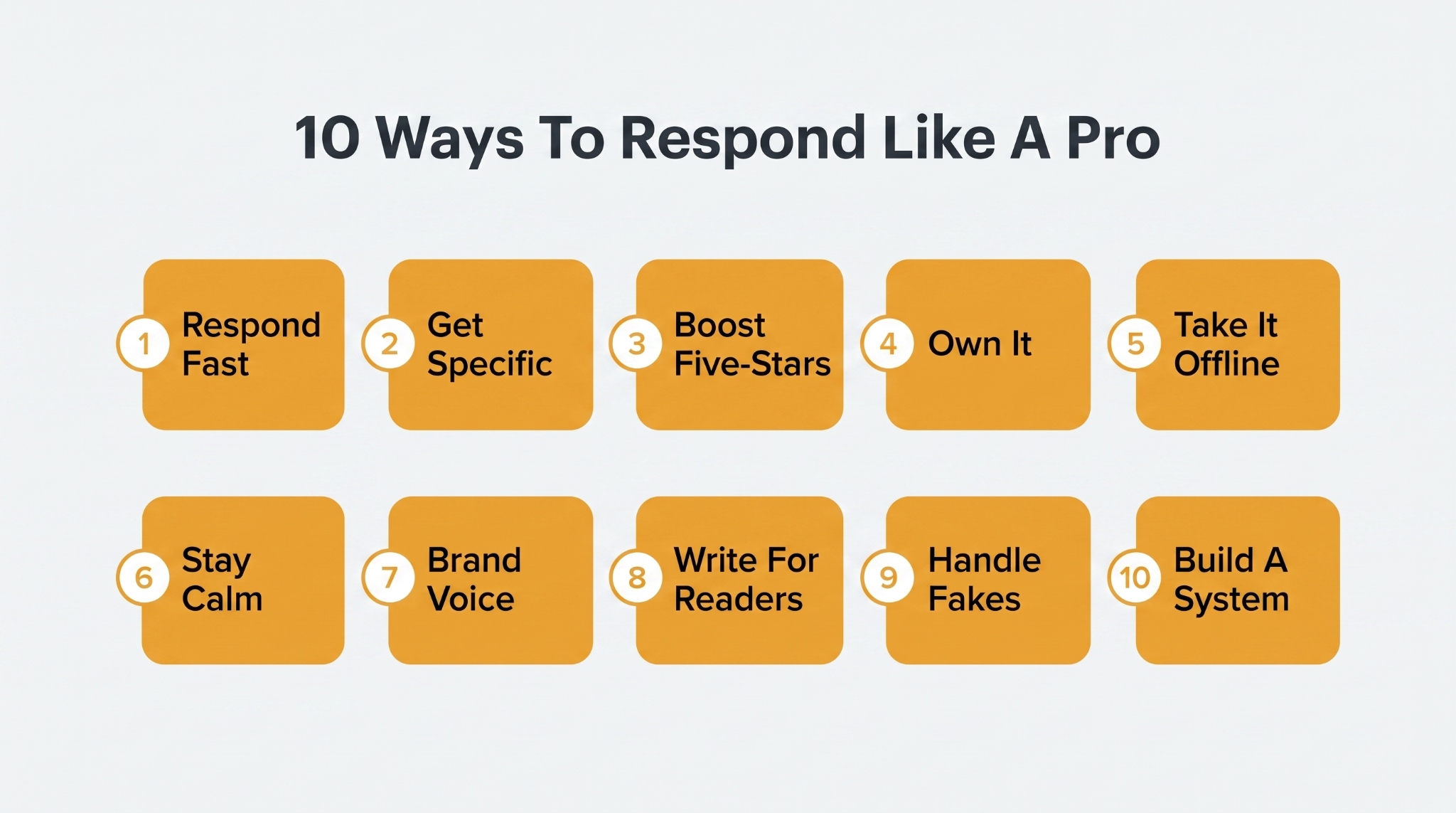
Here is how to respond to reviews like a pro – 10 strategies, one for pretty much every situation you will run into. None of them takes long once you settle into the habit. And together they cover just about every review that will ever show up on your profile.
| Review Type | What Your Reply Should Do |
|---|---|
| Glowing five-star | Thank satisfied customers and gently invite them back for more |
| Angry one-star | Apologize and own it, then take it offline |
| Mixed three-star | Acknowledge the fair point and show you’re fixing it |
| Fake or spam | Reply factually or report it, but never admit fault |
1. Respond Fast, While It Still Matters
A reply that turns up three months late basically tells the existing customer you forgot they existed. Answer quickly, and it is clear a real person is paying attention right now, while the review still means something to whoever wrote it and everyone reading over their shoulder. The longer one goes ignored, the more it looks like nobody is home.
And people’s patience keeps shrinking – 63% now expect a reply within a week, the same speed pressure that rewards whoever gets to a lead first.
- Set a target to reply to every review within one business day.
- Turn on alerts so a new review never goes unnoticed.
- Keep quick reply skeletons for common review types so you move faster.
- Clear your backlog of old unanswered reviews before worrying about new ones.
2. Reference The Exact Thing They Mentioned
A generic thanks for the kind words basically announces that you didn’t really read the review. The trick is being specific. A good review response always sounds personal.
Name the exact product they loved or the team member who helped them, and it is obvious a human actually paid attention. Copy-paste replies do the reverse and tell everyone you are only replying because you have to.
- Quote or name the specific thing the reviewer actually praised or raised.
- Use the reviewer’s first name so they know the reply was actually meant for them.
- Mention the exact team member they named and pass their praise along.
- Never paste the exact same worded reply under two separate customer reviews.
3. Handle Glowing Reviews Without Wasting Them
Most businesses fumble positive feedback with a lazy thanks. But a five-star review is two things at once: a happy customer and a little sales pitch to everyone who reads it later. Past saying thank you, that positive response is your chance to underline what you are good at and nudge them back as repeat customers.
- Thank them for the wonderful review, then reinforce the specific strength that shows your exceptional service.
- Invite the happy customer back for a specific related product or service to encourage repeat business.
- Add one subtle detail about the outstanding service that reminds readers what helped create that positive experience and sells your strength to the next reader.
- Keep the warmth real instead of gushing in an over-the-top, fake way.
4. Own The Problem Instead Of Getting Defensive
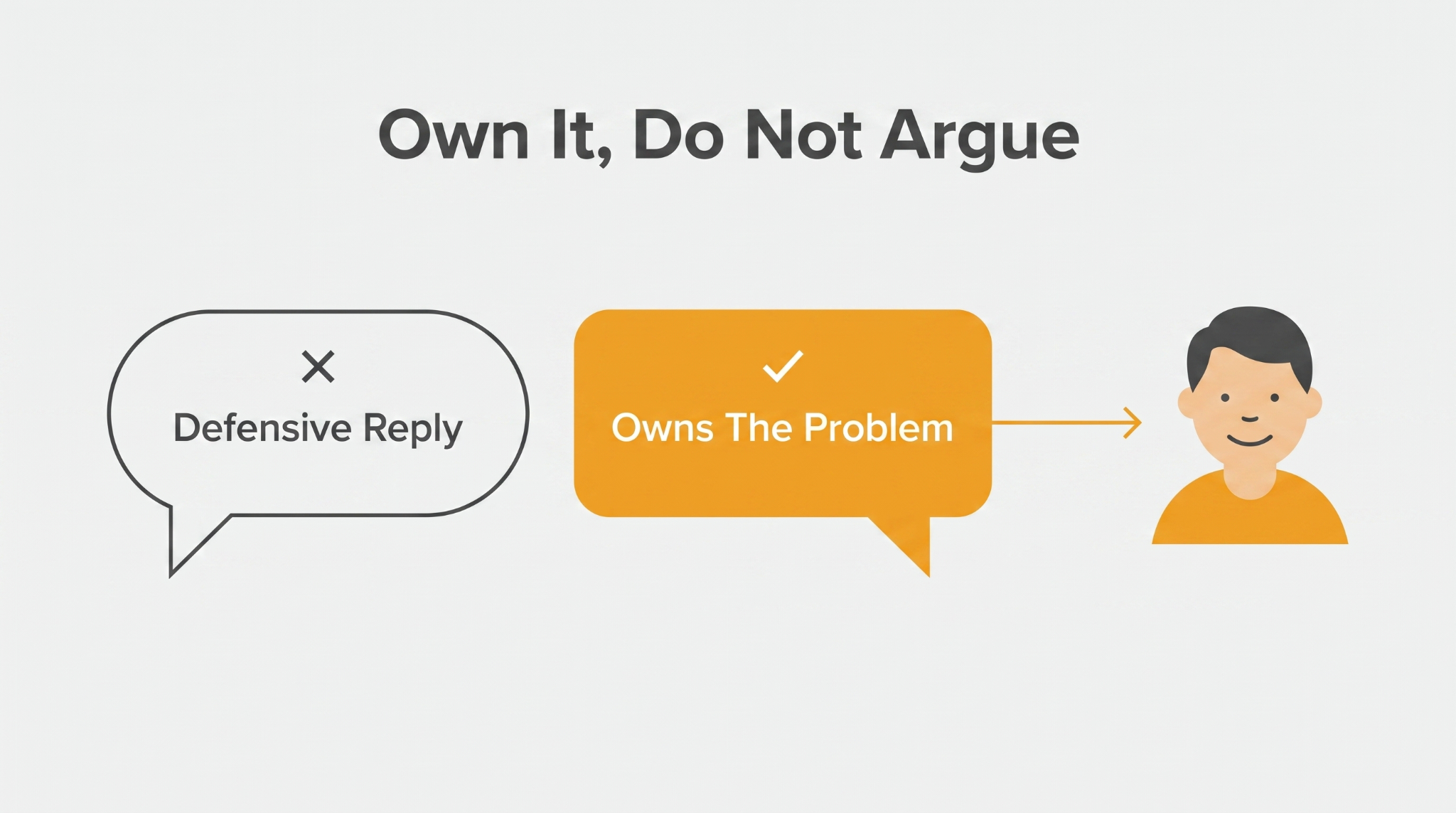
When you get a bad review, every instinct tells you to defend yourself and explain why the customer has got it wrong. Don’t. Every potential customer is watching how you handle negative feedback. And a defensive negative review response makes you look worse than the complaint ever could. Owning the issue, even partly, feels grown-up and lowers the temperature.
- Start with a genuine apology for the negative experience before you explain anything.
- Own the specific part that was genuinely your fault – plainly and without excuses.
- Say what you have actually changed so it will not happen again.
- Keep it short, because a long defense just reads like making excuses.
5. Take The Heated Ones Offline
Some negative comments just spiral if you try to sort them out in public, comment after comment. The pros post one calm reply and then move the real fix to a private channel where the actual details can get worked out. Everyone sees that you responded and cared, and the rest of the discussion happens where it belongs.
- Post one short public reply. Then invite them to message you directly.
- Give a direct email or phone line, not a generic support form.
- Offer to get on a quick screen-share call to sort the details live.
- Post a brief public update once it is fixed so readers see the resolution.
6. Never Argue Or Get Emotional In Public
Even when a review is flat-out unfair, and you are fuming, your public reply isn’t the place to prove it. Arguing makes you look thin-skinned to every future customer. And it never changes the reviewer’s mind anyway. Staying composed reads as confidence. A calm and factual reply beats a heated one with the silent audience.
- Draft the reply, then wait an hour before you actually post it.
- Correct any wrong facts politely, without ever calling the reviewer a liar.
- Never reach for sarcasm or an all-caps outburst in your public reply.
- Have a second person read any heated reply before it goes out.
7. Keep Your Brand Voice In Every Reply
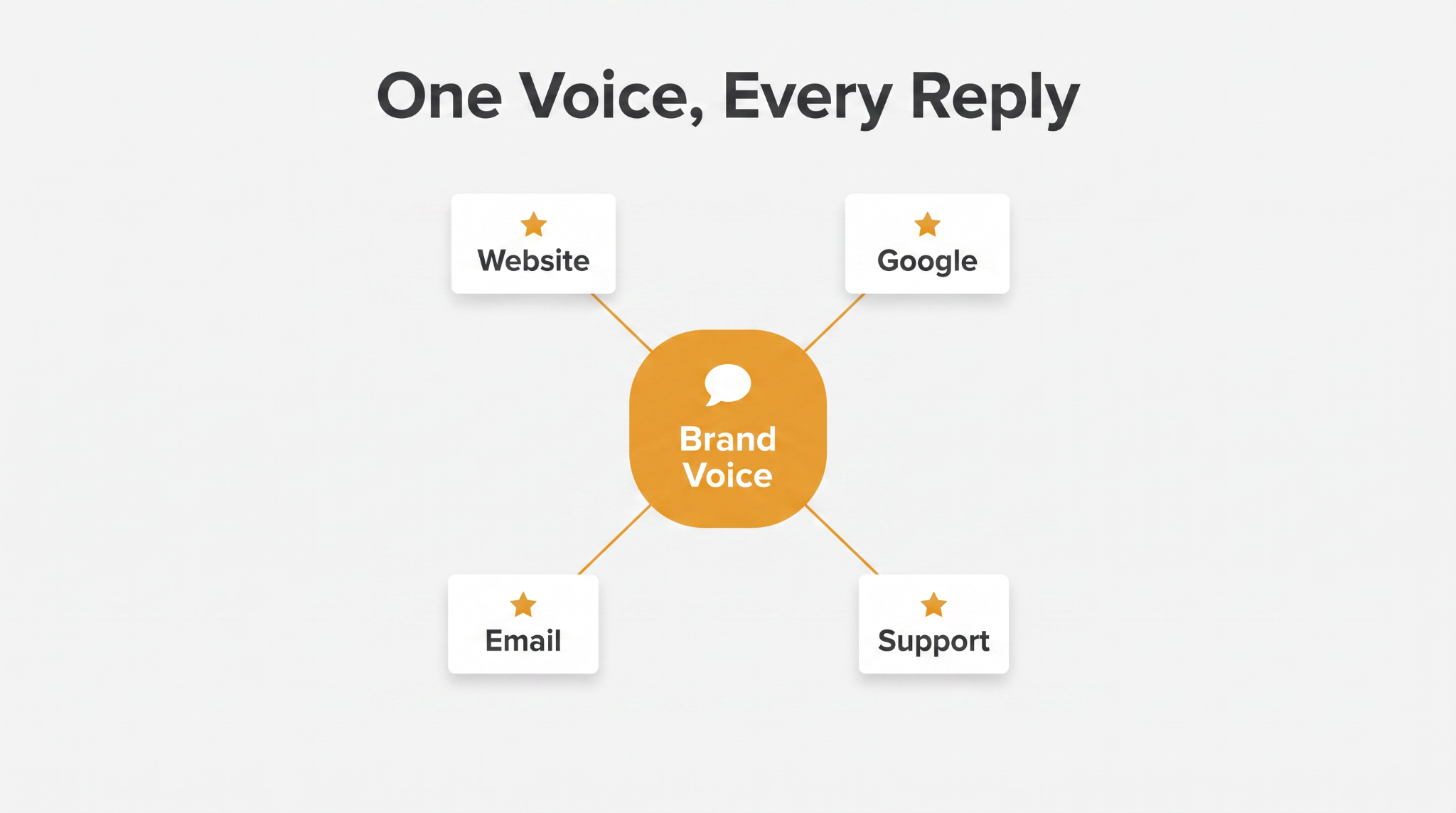
A reply that reads like a legal disclaimer kills the personality people came to you for. Your responses are part of your brand, not some separate corporate channel sitting off to the side. If you are warm and playful everywhere else, a stiff robotic reply looks jarring. Sounding like you makes the whole brand hang together as one real thing.
- Write every reply in the same tone as your website and emails.
- Give the team a short voice guide made just for review responses.
- Let a real personality show instead of hiding behind stiff corporate formality.
- Skip the business language that no actual human would ever say aloud.
8. Write The Reply For The Next Reader, Not The Reviewer
This one is a mindset shift that separates the pros. When you reply, you are not really writing to the person who left the review. You are writing to the 100 prospective customers who will read it while deciding whether to trust you. Write for that silent crowd, and every reply becomes honest marketing even after the customer leaves.
- Answer the exact worry a future reader will silently be having too.
- Slip one relevant search keyword in naturally, never obviously stuffed in there.
- Restate that a past problem is now fixed so readers see resolution.
- Leave the future reader reassured, not only the original reviewer politely thanked.
9. Deal With Fake And Unfair Reviews The Right Way
Not every bad review is even real. Some come from competitors or bots, others from people who never bought anything from you. The mistake is treating a fake like honest feedback or blowing up at it in public for everyone to see. There is a calm and deliberate way to handle these. And it protects you far better than swinging back.
- Report any clear policy violation to the review platform before you reply publicly.
- Reply factually. Note politely that you have no record of this transaction.
- Never admit fault or apologize for something that did not actually happen.
- Keep screenshots and evidence in case you need to escalate a removal.
10. Turn Responding Into A Repeatable System
Replying well once is easy. Doing it for every single review, forever, without it swallowing your whole week, takes an actual system. Leave it to willpower, and the replies get skipped the second things get busy. Build a system so your team consistently answers its own reviews.
Building a system so your team consistently answers its own reviews is what turns good intentions into replies that genuinely go out.
- Assign one clear owner who is responsible for every single review response.
- Block a fixed weekly slot to read and reply to new reviews.
- Build yourself a repeatable follow-up habit around a few lightweight reply templates.
- Track your response rate and reply time monthly, then close the gaps.
4 Review Response Examples Worth Copying
Here are 4 real businesses that show how to respond to reviews the right way. Pay attention to what they actually write because that is where the real lesson is. And notice that all 4 reply to both positive and negative reviews, not just the flattering ones.
1. NightVision Outdoor Lighting: How to Answer a Negative Review
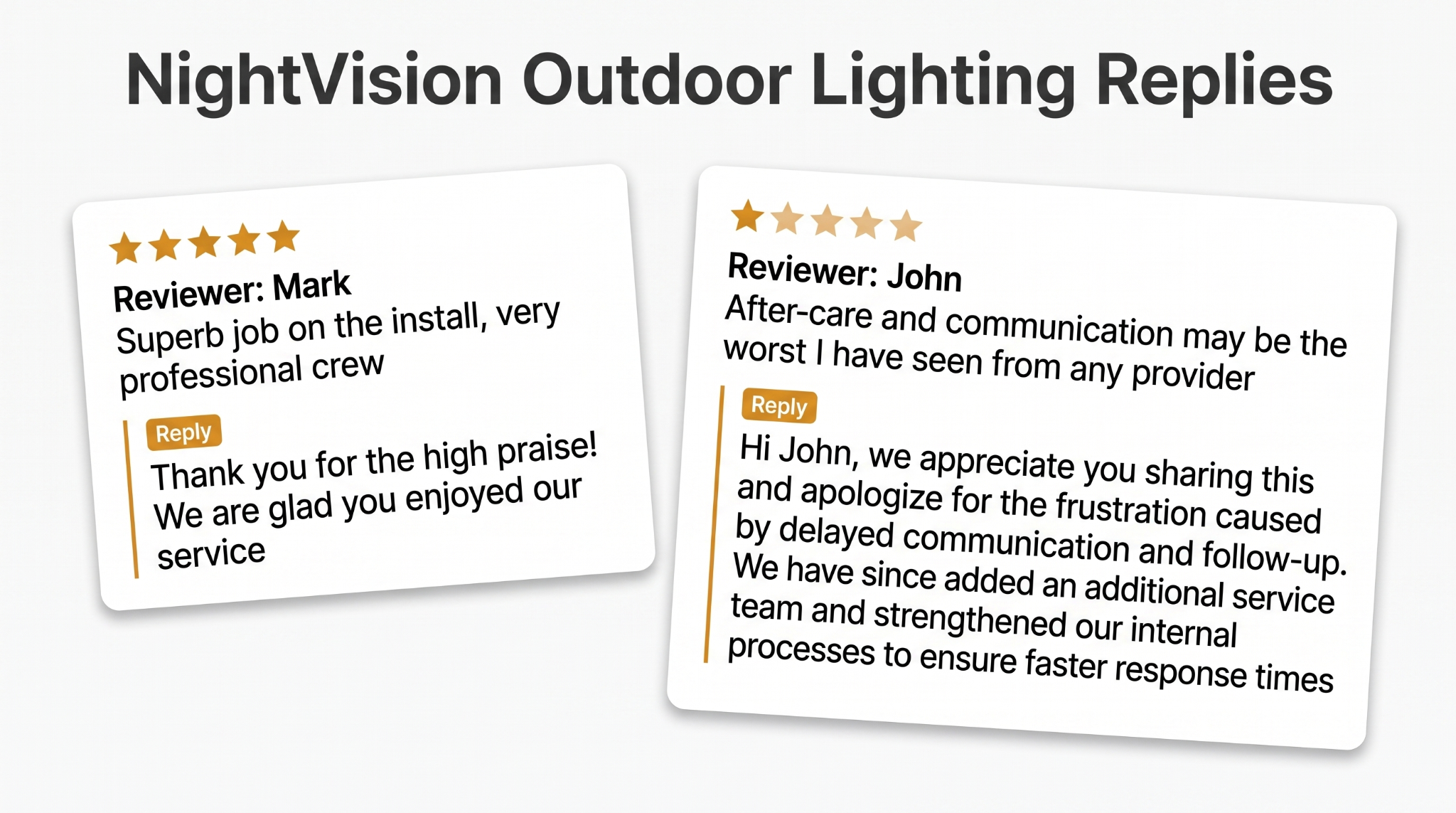
NightVision Outdoor Lighting is a Georgia company holding a 4.8 across a couple hundred Google reviews. What jumps out is that they reply to nearly everything. The happy reviews get short, warm notes like “Thank you for the high praise! We’re glad you enjoyed our service,” which is pleasant enough but not the interesting bit.
The interesting bit is how they handle a genuinely brutal one-star. One customer wrote that they were unhappy with the after-care and communication. That is exactly the kind of review that scares off buyers. Most companies would either ignore it or get defensive and start listing excuses for what happened.
NightVision did neither. They opened with a real apology, named the exact failing, then said what they had fixed: “We’ve since added an additional service team and strengthened our internal processes to ensure faster response times.” No arguing, no spin.
That short reply does a lot in just a few lines. Naming the specific problem shows they actually read it and aren’t hiding. Pointing to a concrete change, a whole new service team, tells the next reader this wasn’t brushed off. The complaint stops reading as a red flag and becomes proof they fix things.
Your takeaway: a one-star doesn’t have to sink you. Own the exact failure, then point to the specific thing you changed instead of making excuses. Done right, the reply reassures every future customer that problems here actually get handled.
It also signals excellent customer service even after something went wrong. All this costs nothing but a little humility, and it plainly works on the people still deciding.
2. Nootropics Depot: When to Take a Complaint Private
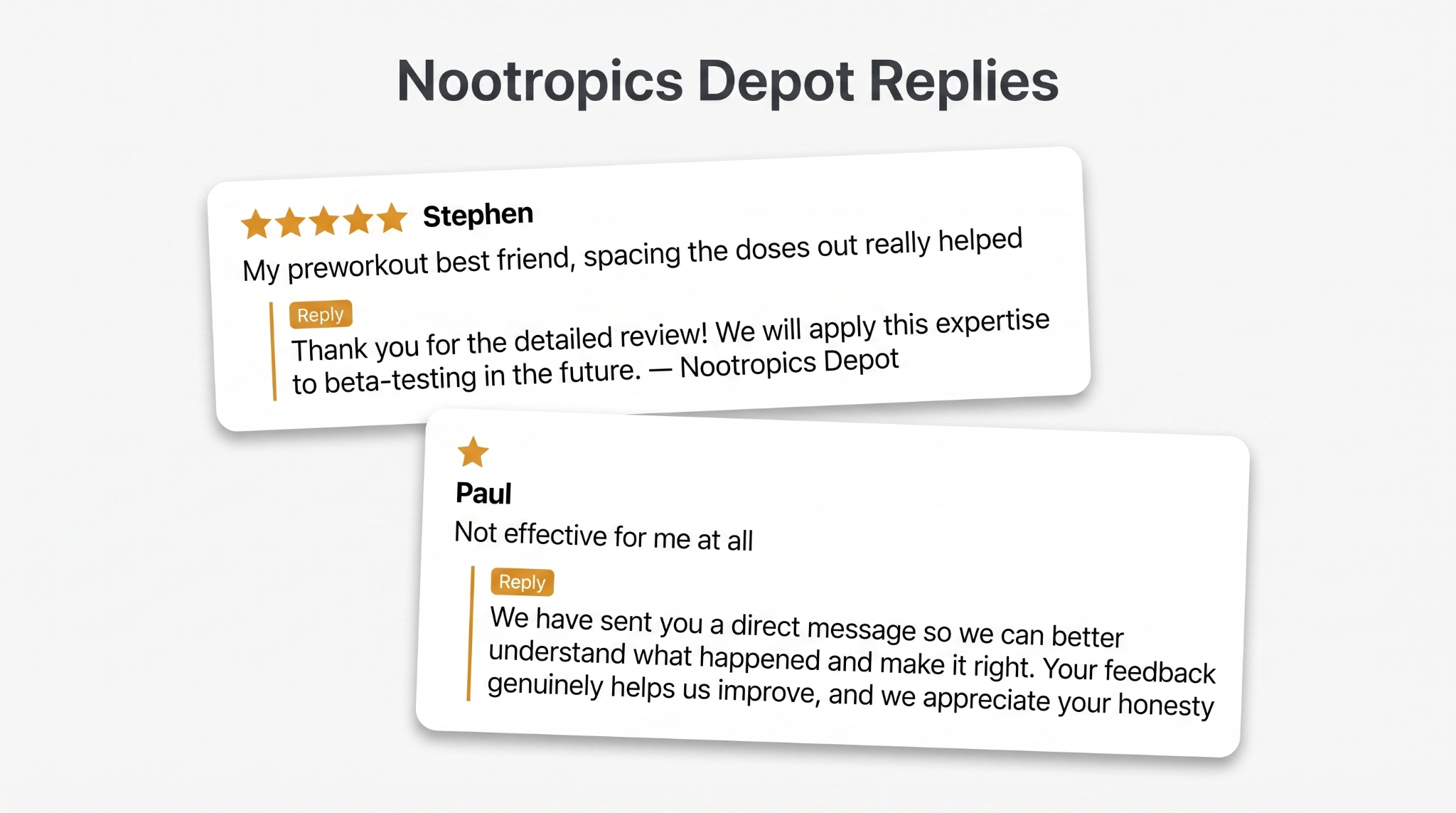
Nootropics Depot’s supplement store replies to product reviews most companies wouldn’t touch, right down to a furious one titled “.0000001 Stars.” Every single reply is signed “Nootropics Depot” and engages the actual detail of what the customer said, rather than pasting the same tired line under everything.
When one reviewer explained how spacing out the doses had worked for them, the brand didn’t just say thanks. They wrote back that they would “take this expertise and apply it to beta-testing in the future.” That turns a happy customer into someone who feels genuinely heard, and it shows other readers the brand is paying attention.
Their real signature move is on the negatives, though: they take it private. To one unhappy buyer, they replied, “We’ve sent you a DM to figure out how we can make this right.” To another, “We’ve sent you a direct message so we can better understand what happened and make it right.”
That approach threads a needle nicely. The short public reply shows everyone scrolling that the complaint got a fast and human response. Meanwhile, the messy specifics, the order details and what actually went wrong, get sorted in a DM where they belong. Readers see care without watching a drawn-out argument.
This is the take-it-offline idea working in real life. A warm public reply, paired with a private message that does the actual fixing, keeps the ugly details off your thread. And it reassures every future reader that a complaint here gets real, personal attention instead of a canned apology.
3. Holtkamp HVAC & Plumbing: Why Personal Replies Build Trust
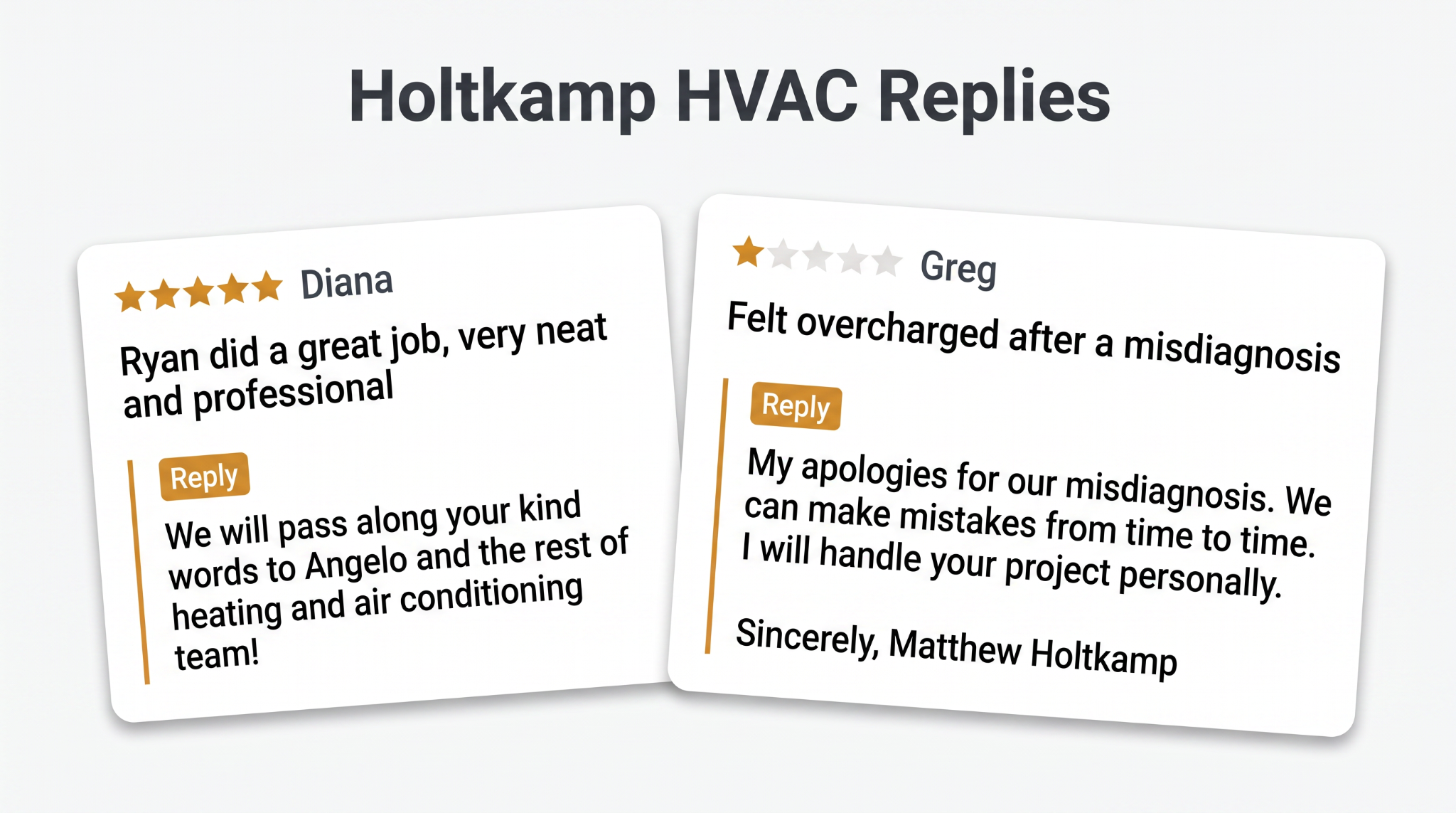
Holtkamp HVAC & Plumbing’s air conditioning installation service in Suwanee, GA has over 1,100 reviews, and their replies are strikingly personal. In almost every one, they name the specific technician and pass the praise straight along: “We’ll pass along your kind words to Angelo and the rest of our heating and air conditioning team.”
That one small habit changes how the reply reads. Instead of a faceless “thanks for your valuable feedback,” there is a real name and a real crew attached to it. It signals that the people who did the work will actually hear the compliment, which makes the whole thing read as human instead of automated boilerplate.
The negatives are where it gets genuinely impressive. When a customer felt overcharged after a misdiagnosis, the owner himself stepped in and signed his name: “My apologies for our misdiagnosis. We can make mistakes from time to time.” On another rough one, he offered to handle the project personally and left his direct phone number.
Look at what that owner’s reply accomplishes. Admitting a mistake in public is disarming, and it is the opposite of the defensiveness people brace themselves for. Signing a real name and handing over a direct line proves there is nobody hiding behind a support queue. The next reader sees a business that owns its errors out loud.
Borrow the personal touch for yourself. Naming the actual person who did the work turns a boilerplate thank-you into something that reads as if a human wrote it. And when the owner signs an apology and hands over a direct line, it tells every reader this business genuinely stands behind what it does. That is exactly what people expect from the best customer service businesses.
4. Mind Lab Pro: Coach the Reviewer, Do Not Just Apologize
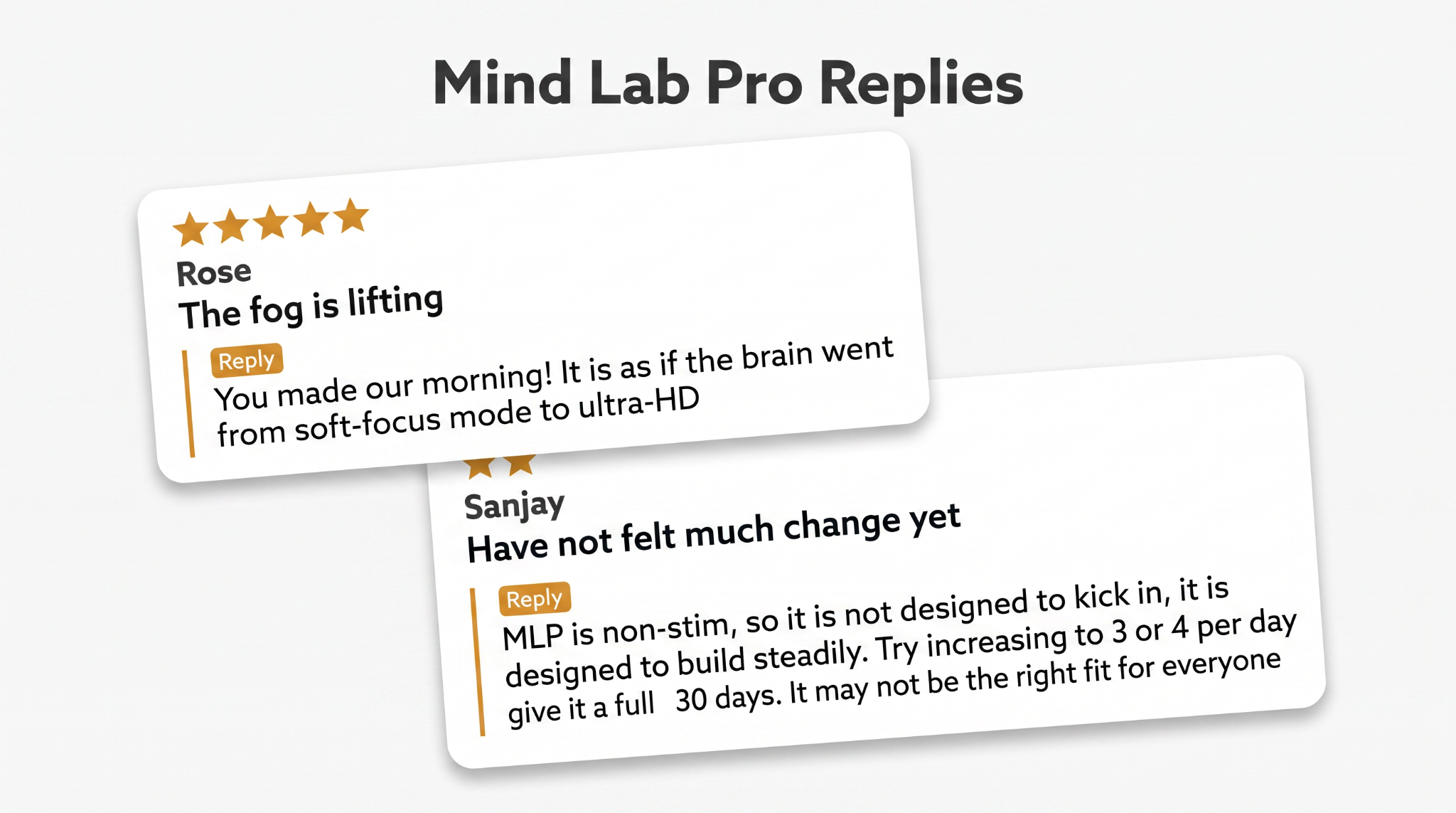
The positive review response examples from the nootropic brand Mind Lab Pro have a personality you could pick out of a lineup. To a happy customer whose brain fog had lifted, they wrote: “It’s as if the brain used to be switched to soft-focus mode, and now it’s moving to ultra-HD.” Nobody would ever mistake that line for a template.
That voice does something subtle. A reply this distinctive makes the brand memorable and reinforces its whole identity around clear thinking. To another reviewer who had just passed an exam, they opened with a genuine “congratulations on passing on the first attempt,” speaking to the person rather than the star rating.
The two-star replies are the masterclass, though. Rather than an empty apology, they actually coach. They explained the product is non-stim, so “it isn’t designed to kick in, it’s designed to build steadily,” then suggested trying three to four capsules a day for a full 30 days before judging it.
That reply flips a complaint into something useful. It reframes the disappointment as a fixable usage issue, gives a specific next step, and stays honest enough to admit the product “may not be the right fit for everyone.” Future readers don’t see damage control here; they see a brand that clearly knows its own product.
Two things to copy here. Let your real voice into your replies so they actually sound like your brand, and treat a lukewarm review as a coaching moment instead of a fire to put out. Specific, honest help beats a hollow sorry every time, and it does far more to encourage customers reading along.
Conclusion
Responding to reviews isn’t just damage control. It is one of the cheapest public ways to build trust you have got, and hardly anyone does it well. Reply quickly and stay human, then write for the next reader as much as the reviewer.
Do that, and how to respond to reviews becomes a real advantage. And this also makes it easier for more people to provide feedback in the future. That is what good online review management is about.
We built CrankWheel for the moment when a written reply isn’t enough, and you need to talk something through with a customer. It lets you share your screen in seconds on any device, with nothing for them to download, so a tense conversation becomes a quick, human demo. Take a look now.
Frequently Asked Questions
Why is it important to know how to respond to online reviews?
Knowing how to respond to online reviews is essential because it directly influences brand perception and builds trust with prospective customers. Active engagement signals that a business values customer feedback, which can improve local search visibility and help convert dissatisfied customers into loyal brand advocates for the organization.
How does review response management impact local search engine optimization?
Review response management acts as a powerful ranking signal for search engines like Google by demonstrating consistent business activity. Posting fresh, keyword-rich replies to customer feedback signals that a business is active, which helps increase visibility in local search results compared to competitors who leave their profiles dormant and unmanaged.
What is the best way to handle a negative review publicly?
The best way to handle a negative review is to practice accountability by offering a genuine, non-defensive apology for the specific issue. After acknowledging the problem publicly, businesses should transition the complex dispute to a private communication channel to resolve the details without escalating the conflict in a public forum.
Should businesses use templates when replying to customer feedback?
Businesses should avoid using identical copy-paste templates because they signal a lack of genuine attention. Instead, personalize every response by referencing specific customer details, such as the product purchased or the team member involved, to ensure the reply feels human, authentic, and tailored to the individual customer experience.
About the author
Burkhard Berger is the founder of Novum™. He helps innovative B2B companies implement modern SEO strategies to scale their organic traffic to 1,000,000+ visitors per month. Curious about what your true traffic potential is?