
Account-Based Marketing: Definition, Examples & Best Practices
Account-based marketing sits in its own lane. And it should. It lets you decide which accounts deserve your time. You can start conversations that are intentional. You get to create momentum inside a small circle instead of chasing everyone under the sun. And it is ridiculously satisfying when you see it working.

If that sounds like the kind of marketing you want, you are in the right place. In this article, we will explain what account-based marketing is and show examples that make it obvious why it works. We will also share 8 ABM best practices that make it repeatable.
What Is Account-Based Marketing?
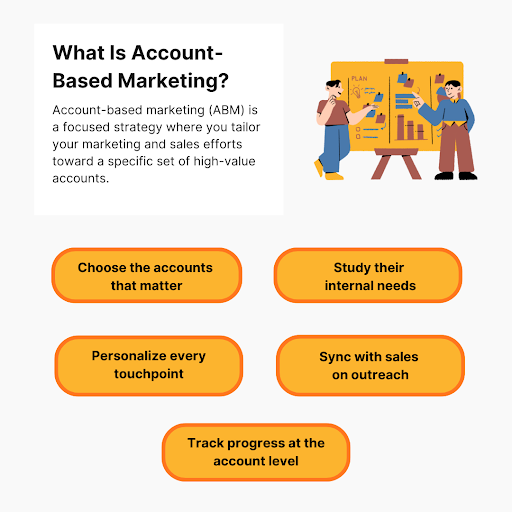
Account-based marketing (ABM) is a strategy where you focus your marketing and sales efforts on a specific list of high-value accounts instead of trying to attract a broad audience. In a successful ABM strategy, you:
- Identify accounts that matter most
- Learn what is happening inside those organizations
- Create personalized campaigns for their decision-makers
- Work closely with sales to move those specific accounts through the pipeline
Account-based marketing aligns marketing and sales teams around the same high-value target accounts and gives those accounts a customized experience that feels timely and intentional.
The 3 Core Types Of Account-Based Marketing
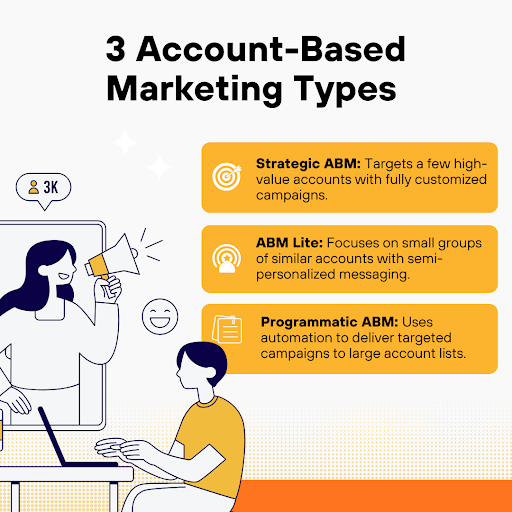
Let’s look at the 3 account-based marketing types so you can see which one fits your strategy and when to use each.
1. Strategic ABM (One-to-One ABM)
This is the most personalized form of ABM. Your team focuses on a very small number of high-value accounts and builds custom marketing campaigns for each one. Every touchpoint feels like it was designed only for that company.
Best For:
- Large enterprise accounts with complex buying committees
- Long sales cycles that need deep relationship-building
- Deals with high customer lifetime value
- Situations where you want custom messaging for each individual account
2. ABM Lite (One-to-Few ABM)
ABM Lite targets small clusters of accounts with shared characteristics. You personalize your messaging, but not to the level of one-to-one. It has customized ABM campaigns designed for small segments rather than individual companies.
Best For:
- Mid-market accounts with similar needs
- Scenarios where you want personalization without heavy resources
- Selling to a niche industry or vertical
- Sales and marketing teams building momentum before scaling to full Strategic ABM
3. Programmatic ABM (One-to-Many ABM)
Programmatic ABM uses technology to reach a large group of target accounts at scale. It is still targeted – you are not marketing to everyone – but it relies on automation and dynamic content to personalize at volume.
Best For:
- Companies with large target account lists
- Scalable campaigns across many industries or segments
- Teams relying on automation and intent signals
- Early-stage account-based marketing programs that need reach with efficiency
Why Account-Based Marketing Matters For Modern B2B Companies: 5 Key Benefits
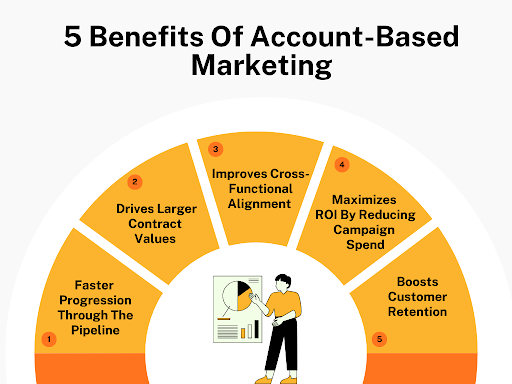
Here are 5 clear benefits that show why the account-based marketing strategy is the way modern B2B companies get results.
1. Faster Progression Of High-Value Accounts Through The Pipeline
When you treat a handful of key accounts like they are the only people you are selling to, the deals move quicker. They don’t need weeks of warming up because your outreach already matches what they care about.
This trims the slow parts of the pipeline. They see emails that make sense to them. They get resources that actually help instead of overwhelm. They get into real conversations faster because nothing is random or vague. The pace picks up naturally.
2. Drives Larger Contract Values Through Deep Account Penetration
Bigger deals happen when more than one person inside the company knows you. ABM helps you do that in a clean and intentional way. Rather than leaning on a single contact, you start showing up for the whole group – the person evaluating the product, the person who signs off on budgets, the person who needs the results.
When everyone is included early on, the deal grows and converts better. They don’t see you as solving one problem. They see you solving the whole cluster of things they deal with.
3. Improves Cross-Functional Alignment Around Shared Revenue Targets
Account-based marketing tactics push your internal teams to stop working in their own bubbles. Sales teams stay focused on the strategic accounts that marketing is actively warming. Product teams understand exactly which use cases matter most.
The marketing-to-sales handoff stops being a messy moment because both sides already know the account’s history and internal dynamics. Everyone is working the same plan, at the same time, toward the same outcomes. It is cleaner and less chaotic.
4. Maximizes ROI By Reducing Spend On Broad Campaigns
ABM programs save money because you stop paying for reach you don’t need. You are not running ads to thousands of random people. You are not creating giant content bundles that nobody reads.
You focus on things built for a small but intentional list that actually matters. Every dollar has a purpose. When you shrink the target audience, the efficiency goes up fast. That clarity also helps with financial planning because your spending finally matches the accounts that generate revenue.
5. Boosts Customer Retention With Long-Term Relationship Building
Retention becomes easier when accounts already feel understood before they even sign the contract. ABM efforts create that dynamic early. They have seen thoughtful outreach. They’ve had conversations that were relevant to their world.
So by the time they become customers, they already trust you. That makes renewals smoother and long-term work natural. You don’t “maintain” the relationship – it simply continues.
8 Account-Based Marketing Best Practices To Strengthen Your Revenue Growth Strategy
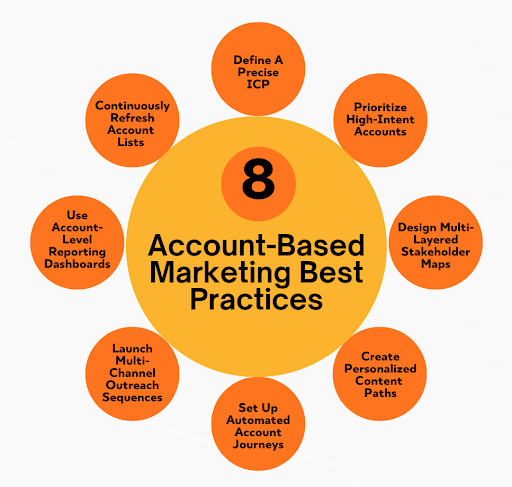
Here are 8 ABM best practices you can start using today to turn the accounts that matter into real wins.
1. Define A Precise ICP Before Building Any Account List
If your Ideal Customer Profile (ICP) is vague, your whole ABM wobbles. You waste time chasing companies that will never buy, and you slow down the accounts that actually would buy if you focused on them. A precise ICP optimizes your sales process through clear lines that tell you who fits and who should be ignored, even if they look tempting from far away.
What To Do:
- Pull the last 12 months of actual closed-won deals and mark the ones that closed quickly AND retained the longest – those patterns form your core ICP.
- Document buying conditions that consistently speed up deals (hiring bursts, new funding, expansion into new regions, tooling upgrades).
- Break your ICP into two buckets – “perfect fit” and “acceptable fit” so your team knows where to spend real energy.
- Write a short internal checklist that the team must validate before any account makes it to the ABM list.
- Keep your ICP page visible in your workspace so everyone filters new accounts the same way.
2. Prioritize High-Intent Accounts With Real-Time Scoring Signals
ABM runs smoother when you know which accounts woke up today thinking about the problem you solve. Real-time scoring helps you separate cold accounts from the ones quietly researching you or experiencing a shift that makes them more open to talking.
This keeps you from working on accounts in the wrong order and ensures your team spends time where momentum already exists.
What To Do:
- Mark specific actions as high-value signals – pricing checks, comparison PDF downloads, repeat views of the same feature.
- Add external signals – new VP hires, funding rounds, major layoffs, tech stack updates, or sudden hiring spikes in relevant roles.
- Create a “hot account” alert in Slack so sales get notified the moment intent crosses a threshold.
- Review signals at the account level, not the individual level – multiple users active at once is a different type of heat.
- Refresh thresholds monthly so your scoring doesn’t get stale as patterns change.
3. Design Multi-Layered Stakeholder Maps Inside Every Account
Every account is a small ecosystem. If you only know one person inside it, you are handicapping the deal without realizing it. A stakeholder map helps you see the whole landscape – who evaluates, who influences, who slows things down, who quietly signs off.
Once you know the map, your outreach becomes cleaner and more confident because everyone gets exactly what they need to keep the deal moving.
What To Do:
- List every person interacting with the product – the user, the evaluator, the finance reviewer, the IT gatekeeper, the final approver.
- Add notes about what key stakeholders care about (risk, speed, cost, usability, compliance, outcomes).
- Identify the “friction makers” early – the ones who stop deals from moving unless they are included.
- Give sales 5 short talking points for each role so conversations don’t rely on generic messaging.
- Keep the map updated after every touch so your picture of the account doesn’t go stale.
4. Create Personalized Content Paths For Each Decision-Maker Role
Different people inside the same account need different types of clarity. The CFO wants numbers. The user wants workflow breakdowns. The VP wants future impact. If everyone gets the same content, you are forcing them to do the work of interpreting it. A content path gives each role exactly the information they want, in the format they prefer.
What To Do:
- Build one content path per role: finance, user, executive, operations, IT — each with its own angle and tone.
- Create short and scannable versions for executives and deeper pieces for evaluators.
- Match every asset to a moment in the deal – early curiosity, active comparison, final justification.
- Keep each path short – 3–5 pieces max – so accounts aren’t overwhelmed by it.
- Create one “anchor asset” for each role – a single resource reps can use as their starting point.
5. Set Up Automated Account Journeys Triggered By Buying Behavior
Automation in ABM is more like “set it so it fires exactly when an account makes a meaningful move.” When someone inside the account starts going deeper, you want the next step to happen instantly – not two days later when someone on your team has time. Automated journeys do that and keep the account warm without losing momentum.
What To Do:
- Trigger journeys by real signals – multiple sessions in a week, revisiting pricing, searching for integrations, downloading a comparison.
- Prepare different journey paths depending on what they viewed – technical vs financial vs user-focused.
- Add fast follow-ups. A same-day direct mail, a LinkedIn nudge, and an optional task for sales if activity spikes unusually high.
- Build “stall recovery” journeys for accounts that slow down so they stay engaged without forcing a hard pitch.
- Test one journey a month to keep timing and relevance sharp.
6. Launch Multi-Channel Outreach Sequences Synced To One Timeline
Scattered outreach makes your brand feel disjointed. You don’t want an ad saying one thing while sales emails something different. You want everything happening on one timeline so the account experiences consistency. This builds familiarity faster and makes outreach thoughtful.
What To Do:
- Build a clear timeline (30, 45, or 60 days) and list which channels activate at each stage.
- Sync messages so every touch reinforces the same angle that week.
- Use ads for passive awareness and sales for active account engagement, so both roles aren’t fighting for attention.
- Prepare “weekly themes” so the account sees one story at a time instead of mixed messaging.
- Keep the creative consistent – tone, language, value prop, and visuals all matching.
7. Use Account-Level Reporting Dashboards To Track Momentum
When you implement account-based marketing, individual metrics don’t tell you much. What matters is how the account moves as a whole. A dashboard helps you see this at a glance – how many roles are active, what content they are touching, how often they return, and where they slow down. When you can see momentum, you can respond before the account cools off.
What To Do:
- Track actions grouped into stages – awareness actions, comparison actions, purchase actions.
- Add a simple momentum score: high activity across roles = high score, isolated activity = low score.
- Highlight where accounts stall so sales know exactly where to re-engage accounts.
- Show which roles are missing from the conversation – that usually signals the next outreach angle.
- Review dashboard data weekly and update your approach based on what is actually moving accounts.
8. Continuously Refresh Account Lists With Market And Firmographic Shifts
Your ABM is a working document. Markets shift. Teams get restructured. Budgets grow or disappear. A great account in January might be a dead end in June. Refresh the list to keep your account-based marketing efforts sharp and avoid pouring effort into accounts that can’t buy anymore.
What To Do:
- Check accounts monthly for changes: leadership turnover, new funding, layoffs, product launches, market shifts.
- Move stagnant accounts into a lower tier so they don’t drain attention.
- Add rising companies that recently hit your ICP criteria – especially ones looking to expand business.
- Remove accounts that show repeated disengagement so outreach energy stays high-quality.
- Adjust messaging for accounts undergoing big internal changes so your outreach is always relevant.
3 Account-Based Marketing Examples Worth Copying
Here are 3 companies that faced very different challenges and used their own set of ABM strategies so well that they are worth studying.
1. GetSafe
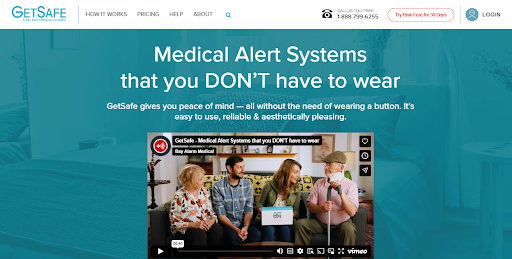
GetSafe provides medical alert systems and remote monitoring technology for senior living facilities, home-care agencies, rehabilitation centers, and healthcare networks.
The Problem They Faced:
Their enterprise pipeline slowed down because large care organizations needed clearer proof of operational impact. Many key prospects were stuck in “evaluation mode,” and wanted evidence that GetSafe could lower staff workload, reduce emergency escalations, and integrate cleanly with existing care-management workflows.
How They Used ABM:
- They built account dossiers for each target facility group, including resident volume, incident frequency, staffing patterns, and compliance gaps.
- GetSafe offered a 14-day pilot configured to that facility’s floor plan and room type distribution. The pitch wasn’t “try our device” – it was “see your real building running on our system.”
- They developed care-path stakeholder maps that identified everyone involved – nursing directors, care coordinators, operations leads, safety supervisors, and compliance officers. Each was mapped with unique concerns and influence levels.
- GetSafe launched role-based content tracks, such as a staffing-efficiency brief for operations directors and a compliance shortcut guide for regulatory teams.
- They set up behavior-triggered journeys. When an account viewed the “multi-facility deployment” section on the site, an automated sequence triggered with case results and a facility-specific rollout plan.
2. DialMyCalls

DialMyCalls centralizes emergency notifications and real-time broadcast messaging for different organizations – municipalities, school districts, large nonprofits, logistics companies, and enterprise operations teams.
The Problem They Faced:
Enterprise prospects were concerned about scale and systems compatibility. Their mid-market deals moved smoothly, but larger organizations stalled because they needed deeper validation around uptime and internal adoption.
How They Used ABM:
- DialMyCalls built intent scoring for crisis-driven accounts. It monitored when safety officers or communications teams from a target domain searched for terms like “mass notification uptime” or “incident response automation.”
- They created account-specific integration roadmaps that showed how DialMyCalls would connect with the target’s internal communication stack.
- DialMyCalls mapped decision layers for each large organization. Each layer received custom content, not repurposed templates.
- They produced scenario-based demos that mirrored the exact crises each account handles – weather disruptions for logistics firms, lockdown protocols for school districts, system failure alerts for utilities.
- DialMyCalls set automated workflows to trigger when an account crossed a specific intent threshold, moving them into a timeline with a dedicated implementation advisor.
3. Sewing Parts Online
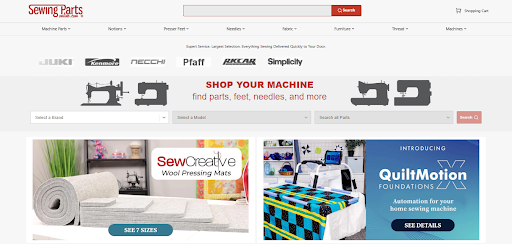
Sewing Parts Online supplies industrial sewing equipment and machine upgrade kits to small manufacturing shops and quilting production studios. Their catalog includes machines like the Juki TL-2000Qi, plus all related accessories and maintenance parts.
The Problem They Faced:
High-value accounts were buying inconsistently. Production managers were placing scattered orders tied to machine breakdowns instead of planning maintenance in advance. This made forecasting hard and revenue potential unpredictable, even though these existing accounts had large lifetime value.
How They Used ABM:
- Sewing Parts Online identified existing customer accounts with multi-machine setups and built equipment lifecycle profiles showing usage hours and component wear predictions.
- They built role-based personas for each production team – the studio owner (budget), the lead quilter or machinist (performance), the maintenance tech (parts continuity).
- Because these accounts depend on tangible personal property to keep production running, they tailored their messaging around equipment lifecycles and wear patterns.
- Sewing Parts Online created machine-specific content paths for different models – maintenance guides and parts-life calculators for the exact machines a shop owned.
- They set up automated reorder triggers based on predicted wear cycles, so when a machine hit a threshold, the account received a pre-approved parts quote and deployment schedule.
- Sewing Parts Online used account dashboards to track service intervals, parts activity, and engagement on maintenance content. Sales reps only reached out when a studio hit a maintenance risk window or showed readiness for an equipment upgrade.
Conclusion
Account-based marketing works best when you start thinking about real companies and real people. And the secret isn’t fancy account-based marketing tools or massive inbound marketing campaigns – it is discipline.
Know exactly who matters, map the people inside the account, personalize content, and track progress relentlessly. Do it right, and the results will hit harder than anything else in your pipeline.
CrankWheel is built for exactly this kind of high‑focus, account-based sales strategy. It is for teams that live on the phone but want to bring in the power of a visual demo – without turning every call into a tech tutorial.
With CrankWheel, you simply send a link via SMS or email, and in less than 10 seconds, your prospect is looking at your screen. No downloads, no plugins, no friction. And it works on any browser, any device.
Try CrankWheel free and start showing your accounts exactly what matters.
About the author:
Burkhard Berger is the founder of Novum™. He helps innovative B2B companies implement modern SEO strategies to scale their organic traffic to 1,000,000+ visitors per month. Curious about what your true traffic potential is?